
A pet food label tells you five things: who the food is for (species and life stage), whether it is a complete food or a complementary one, what it is made of (the ingredient list), its nutrient content (the analytical constituents), and how much to feed. Reading these in order takes less than a minute and is the most reliable way to compare two products, whether you are a pet owner, a breeder or a retailer choosing what to stock.
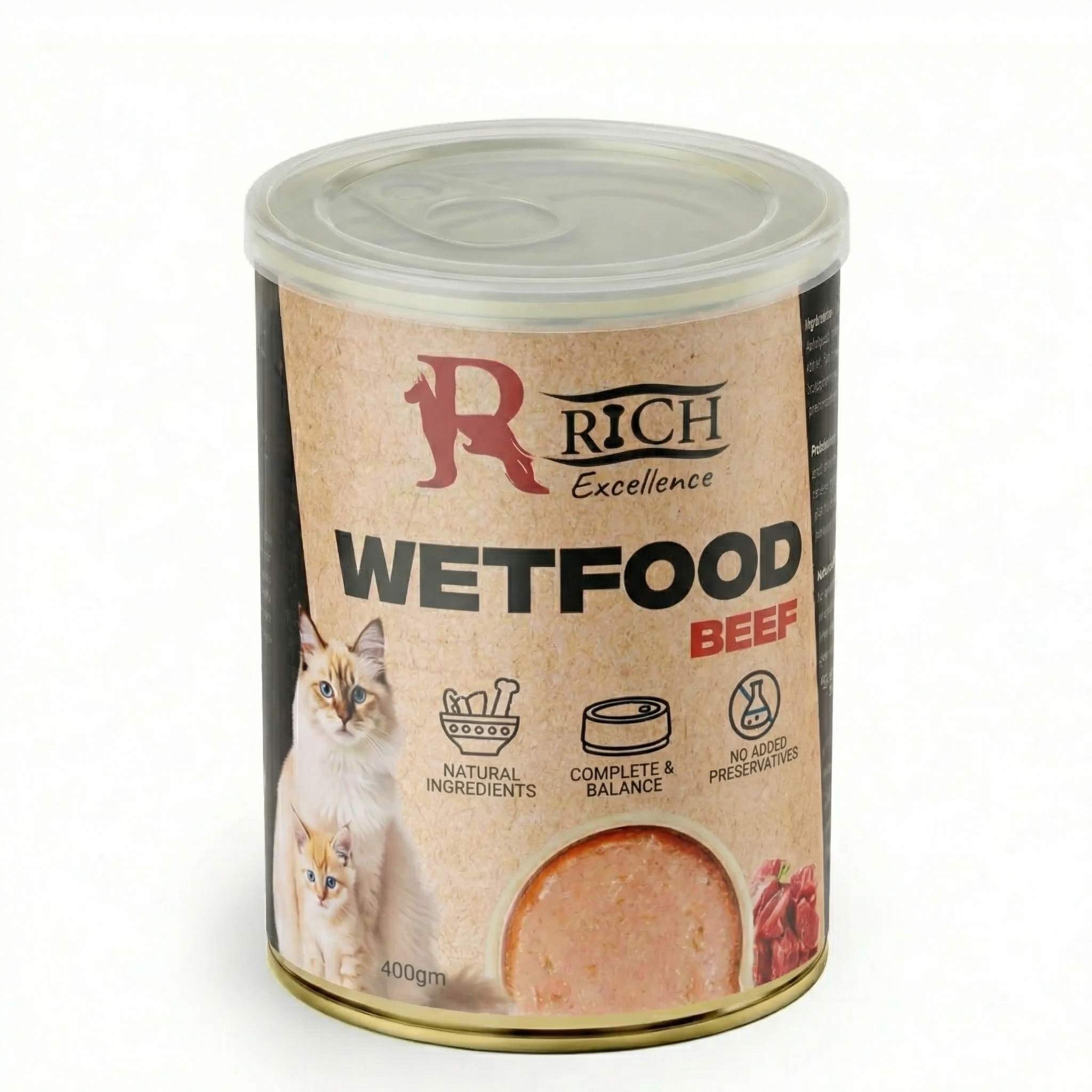
1. Species and life stage
Start with the front of the pack: is it for dogs or cats, and for which stage of life? Puppies and kittens need more energy, protein and minerals for growth than adults; nursing mothers need even more energy to produce milk; very active or working dogs need more calories than a house dog. Feeding a growth formula to an adult, or an adult formula to a growing puppy, is one of the most common feeding mistakes.
At RICH, the life stage is shown on the pack. For example, Rich Excellence dry dog food comes in an Adult formula (26% protein, 9% fat) and a Puppy formula (28% protein, 14% fat), and Rich Excellence dry cat food in an Adult formula and a Kitten formula. See the guide for breeders for the full list.
2. Complete or complementary
A complete food contains everything the animal needs and can be fed on its own as the daily diet. A complementary food, such as a treat, a chew or some wet toppers, is meant to be given alongside a complete food, not instead of it.
Vets commonly advise keeping treats to about 10% of a pet’s daily calories, so that the main diet stays balanced.
3. The ingredient list
Ingredients are listed in descending order by weight, so the first few make up most of the product. Two things to know:
- Fresh meat contains a lot of water, which is lost during cooking, so it can appear first on the list and still be a smaller share of the finished kibble.
- Meat meal (for example chicken meal) is meat with the water already removed, so it is a concentrated protein source.
4. The nutrient table on a pet food label
This table shows the percentage of the main nutrients:
| Line on the label | What it means |
|---|---|
| Crude protein | Total protein. “Crude” refers to the lab method, not to quality. |
| Crude fat (oils and fats) | Main energy source; also carries essential fatty acids. |
| Crude fibre | Indigestible fibre, which supports digestion. |
| Moisture | Water content: about 10% or less in dry food, often around 75 to 80% in wet food. |
| Crude ash | The mineral content (such as calcium and phosphorus). |
How to compare dry food with wet food
Because wet food is mostly water, its percentages look much lower. To compare fairly, convert to dry matter: divide the nutrient percentage by (100 minus the moisture percentage) and multiply by 100.
Example: a wet food with 8% protein and 80% moisture has 8 ÷ 20 × 100 = 40% protein on a dry matter basis, which is higher than many dry foods.
5. Feeding guidelines, dates and storage
- Feeding table: a starting point based on body weight. Adjust to your animal’s body condition and activity, and always provide fresh water.
- Best-before date and batch number: check them when you buy, especially when buying in bulk.
- Storage: keep dry food closed, in a cool and dry place. Once a can is opened, refrigerate it and use it within the time shown on the pack.
Pet food label checks for retailers and distributors
However, a label is only the start. When you evaluate a manufacturer, ask for the full specification of each product: ingredient list, analytical constituents, shelf life and pack sizes. You can ask the RICH team for the specification of any product in the RICH catalog via the contact page.
For more on the nutritional needs of cats and dogs, see the FEDIAF nutritional guidelines published by the European pet food industry federation.
Frequently asked questions
What does “crude protein” mean on pet food?
Crude protein is the total protein measured by a standard laboratory method. The word “crude” describes the method, not the quality of the protein.
How do I compare the protein in wet and dry pet food?
Convert both to dry matter: divide the protein percentage by (100 minus the moisture percentage) and multiply by 100. A wet food with 8% protein and 80% moisture has 40% protein on a dry matter basis.
What is the difference between complete and complementary pet food?
A complete food can be fed alone as the daily diet. A complementary food, such as a treat or topper, is designed to be given alongside a complete food.
How many treats can I give my dog or cat?
Vets commonly advise that treats should make up no more than about 10% of daily calories.
Why is meat listed first if the food is mostly other ingredients?
Ingredients are listed by weight before cooking. Fresh meat is heavy because of its water content, which is lost during processing.